
Current Update News

Thursday, May 20, 2010


Saturday, May 15, 2010
Shama chicks
3 chicks from second clutch of older pair:

One chick from the first clutch of younger pair and his father:
After enjoy a bath


One chick from the first clutch of younger pair and his father:
After enjoy a bath


Thursday, May 13, 2010
Mother birds know best -- even before birth
ScienceDaily (2010-03-27) -- Mother birds communicate with their developing chicks before they even hatch by leaving them messages in the egg, new research has found. By changing conditions within the egg, canary mothers leave a message for their developing chicks about the life they will face after birth. In response, nestlings adjust the development of their begging behaviour.
If chicks get a message that they will be reared by generous parents then they beg more vigorously for food after hatching. But chicks that are destined to be raised by meaner parents end up being much less demanding.
By attending to messages in the egg, nestlings gain weight more rapidly because they match their demands to the parents' supply of food, and can avoid either begging too little or wasting effort on unrewarded begging.
The Cambridge team made the discovery using fostering experiments, exchanging eggs between canaries' nests so that the chicks grew up in an environment that they were not expecting.
"This work changes our understanding of the pre-natal environment in birds," says Dr Rebecca Kilner of the University of Cambridge, who led the research.
"We've known for about twenty years that maternal substances in the egg can influence how chicks develop, but the common assumption is that they are a means by which mothers manipulate their offspring in a way that suits the mother more than the chick.
"What we've shown is the reverse: these substances are actually there to suit the chick. If we muck up the message in the egg experimentally, it is the chick that is penalised directly rather than the mother."
The work was funded by the Natural Environment Research Council, and is published in Science on March 12, 2010.
Source: University of Cambridge (2010, March 27). Mother birds know best -- even before birth. ScienceDaily. Retrieved May 13, 2010, from http://www.sciencedaily.com /releases/2010/03/100311141209.htm#
If chicks get a message that they will be reared by generous parents then they beg more vigorously for food after hatching. But chicks that are destined to be raised by meaner parents end up being much less demanding.
By attending to messages in the egg, nestlings gain weight more rapidly because they match their demands to the parents' supply of food, and can avoid either begging too little or wasting effort on unrewarded begging.
The Cambridge team made the discovery using fostering experiments, exchanging eggs between canaries' nests so that the chicks grew up in an environment that they were not expecting.
"This work changes our understanding of the pre-natal environment in birds," says Dr Rebecca Kilner of the University of Cambridge, who led the research.
"We've known for about twenty years that maternal substances in the egg can influence how chicks develop, but the common assumption is that they are a means by which mothers manipulate their offspring in a way that suits the mother more than the chick.
"What we've shown is the reverse: these substances are actually there to suit the chick. If we muck up the message in the egg experimentally, it is the chick that is penalised directly rather than the mother."
The work was funded by the Natural Environment Research Council, and is published in Science on March 12, 2010.
Source: University of Cambridge (2010, March 27). Mother birds know best -- even before birth. ScienceDaily. Retrieved May 13, 2010, from http://www.sciencedaily.com /releases/2010/03/100311141209.htm#
Friday, May 7, 2010
Hwamei eats Papaya fruit?
There is not much information available about the Hwamei that eat fruits in both wild and in captivity. I know that Hwamei loves to eat peanut, but not fruit. I had tried to feed them orange, grape, strawberry, banana, and none of the fruit that I offered get eaten by the Hwamei. Recently, with the keeping of Troupial pair, I start to feed them with papaya fruit and also throw a few small pieces of papaya for the Hwamei to eat. The pair of Hwamei that live in the aviary did not eat the fruit, but the lone young male Hwamei in the bamboo cage eagerly eats it. Here are some pics of this young male Hwamei eats papaya fruit.
(Please click on the pictures to see bigger pic)


(Please click on the pictures to see bigger pic)


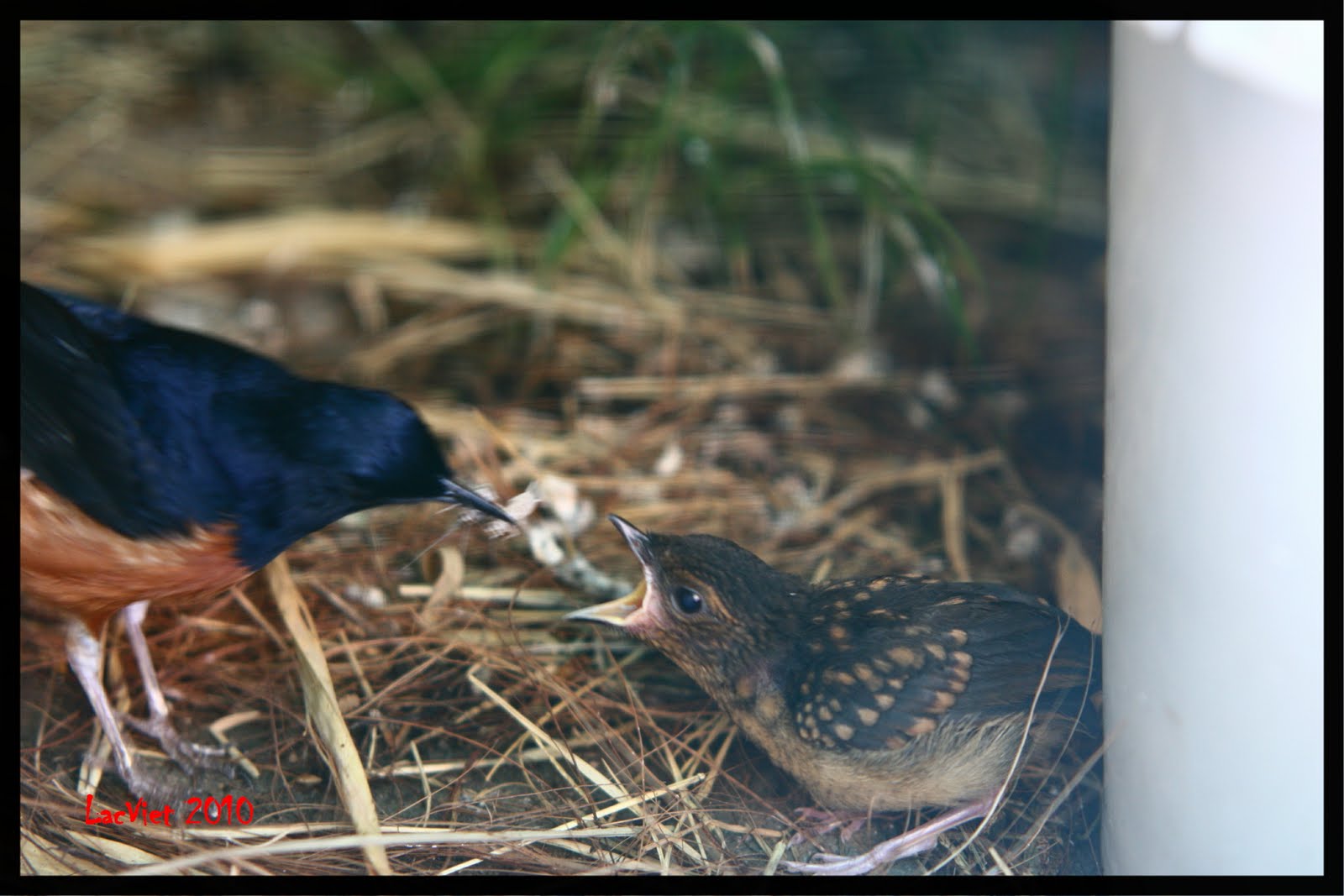
Papa feeds his chick
In previous post, mama bird feeds her chicks. In this post, we can see that papa bird (H1N1) also feeds his chick. From what I observed though my birds, mama bird feed her chicks mostly while the chicks still in the nest (from hatch until about 12 days or so), while papa bird starts to feed his chicks more frequently after the chicks left the nest. The role of mama in feeding her chicks after they left the nest still play an important factor to keep chicks healthy.


1 of 4 series

2 of 4 series
3 of 4 series

4 of 4 series

Thursday, May 6, 2010
Mama feeds her chicks
The superworm is little too big for 13 days old chick so mama has to try to feed her chick a couple times before the chick can get a hold of the superworm and eat it.
(Please click on the pictures to see bigger pic)


(Please click on the pictures to see bigger pic)


Sunday, May 2, 2010
First chick of the H1N1 and H4N1 pair
Only after eleven days staying in the nest, this chick emerges. It's a male and quite handsome :) Hope he will grow up to become a great bird with long tail and sing well.


Serama pet: First egg!
This hen lays egg is little late compare to normal serama hen. She must be around 7 months of age before she lays her first egg. I do plan to hatch few of the eggs just to see how the chick doing in term of color and form, but I won't keep hatching them in large quantity unless some of my friend want to have one.
The hen weights around 400grams or 14ounces which put her in class B per American Serama Standard. The roo weights around 525grams or 18.5ounces which put him in just above class B and should be in class C per American Serama Standard. Again, both of these bird is low quality bird and in term of the form, they are no where near the standard form which set by American Serama Council:
Ideal male: http://www.scnaonline.org/forms/idealmaleupdated.pdf
Ideal female: http://www.scnaonline.org/forms/IdealHenupdated.pdf
Update as of 05/08/2010: The hen laid total of 6 eggs. One got broken, and the rest are start to incubate by the hen on the afternoon of 05/08/2010.


The hen weights around 400grams or 14ounces which put her in class B per American Serama Standard. The roo weights around 525grams or 18.5ounces which put him in just above class B and should be in class C per American Serama Standard. Again, both of these bird is low quality bird and in term of the form, they are no where near the standard form which set by American Serama Council:
Ideal male: http://www.scnaonline.org/forms/idealmaleupdated.pdf
Ideal female: http://www.scnaonline.org/forms/IdealHenupdated.pdf
Update as of 05/08/2010: The hen laid total of 6 eggs. One got broken, and the rest are start to incubate by the hen on the afternoon of 05/08/2010.


Saturday, May 1, 2010
New breeding project: Troupial - Icterus icterus
Little over a month ago, I acquired a female Troupial. After little over a week of letting the pair see each other from separate cage, I let them live together in a small aviary (4ft x 2ft x 6ft) for now and plan to build a similar white-rumped shama size aviary for them at the end of this year. They live in harmony so far but do not act like a bond pair. Male and female are never stay close together. The male is dominant and sometimes attempt to bite the female when she comes near to him. They love crickets, mealworms, superworms, banana, papaya, and anything that is sweet, soft, and orange/red color.
There is not much information on breeding this specie beside some basic information that I can find on internet: http://en.wikipedia.org/wiki/Troupial
Male is on the left, Female is on the right.

There is not much information on breeding this specie beside some basic information that I can find on internet: http://en.wikipedia.org/wiki/Troupial
Male is on the left, Female is on the right.

Subscribe to:
Comments (Atom)
 |