Pages

Current Update News


Protected by Copyscape DMCA Takedown Notice Checker

Monday, June 7, 2010

Pics of H1N1 & H4N1 pair with chicks


Friday, June 4, 2010

Shama pair (H5N1 and H6N2 (used to be H32N2)) 2010 Breeding Season

I'll update things happen to this pair in this thread for this 2010 breeding season.

02/17/2010: The pair is introduced to see each other the first time.  The male is in bamboo cage and he can see his mate in her aviary.
02/27/2010:  Introduce the male into the aviary.
From 02/27 to end of 03/2010:  Both the male and female live happy together in the aviary.  There is no aggression from the male toward the female.  The male sings few times daily but not a courtship song.  Both birds are seems not in the breeding mood probably due to too young (both birds are born last year season).
04/02/2010: Observed the female starts to carrying materials to build the nest (coconut fibers, dried bamboo leaves, small twigs, etc...)
04/09/2010:  Saw broken egg laying inside the bathing container this morning.  Don't really know what happens.  Egg shell seems hard enough, not rubbery so I don't think it dues to soft shell issue.  I took the egg york (still intact) and the egg shell out and put on the aviary floor to take a picture.  Later in the day, Egg york and egg shell are disappear, presumable that either or both of the bird eat them. The female looks fine and acts normal.  She is still sleeping outside tonight.

04/11/2010: The female spend almost an hour inside her nest, probably to lay egg. Hopefully she will start to incubate her eggs soon. This is what her nest looks like:
This type of nest is a small nest that used for several type of finches, not intended for the shama bird.  When I put in the regular wood nest (which normally use for parakeet) over a month ago for them to breed, I didn't think the female will pick this nest and I were too lazy to take it out.  Well, it's too late to do anything now.  Hope she can raise her future chicks successfully in this small nest.
04/12/2010:  Finally she is sleeping inside her nest! So expect eggs to hatch April 23th -24th.  Hopefully eggs are fertilized.
04/25/2010: No sign of eggs hatched yet. If delay hatching in this season is due to outside temperature (based on the observation of other pair of shama who also had eggs around the same time) tomorrow, there should be sign of hatching from this pair. I'll keep my fingers crossed!
05/02/2010: After passed the 14th day mark, I'm sure that the egg(s) are infertile; however, I still let the female incubate her eggs(s) until either she gave up, discard the nest or the eggs(s), or until I take the egg(s) out (which I will probably do so in the next weekend). Hopefully next batch will have better result than this one.
05/13/2010: Did not have a chance to come in the aviary to take the bad eggs out, and did not see the bird discarded any eggs, so I don' know what's going on. However, few days ago, the female starts to rebuild her nest and today, she begins to sleep inside her nest again. Hopefully this time the eggs are fertilized.
05/25/2010: Saw a few pieces of empty egg shells on the floor of aviary today. Finally the lest than one year old male did his job and got fertilize egg(s). I don't know how many eggs the female laid this time but I know for sure that both the parents are proven breeder and able to produce chicks.
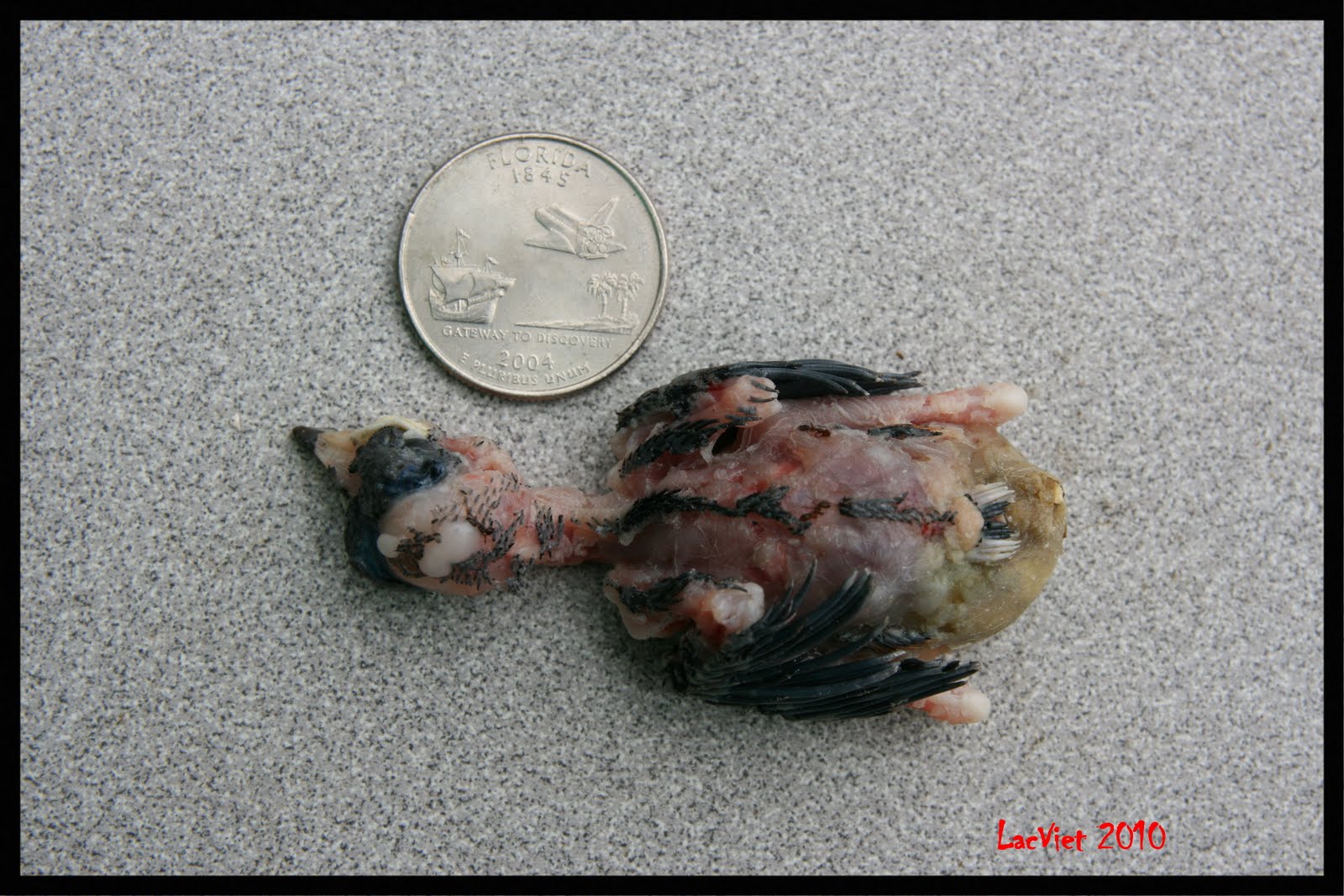
06/04/2010:  Early morning of 06/03/2010 I discovered that one chick died on the floor and covered with common ants.  This chick probably got throw away by the parents the day before in the afternoon.  The reason of death is unknown.  Unless this chick got some kind of disease/virus, my guess is that because of the nest is too small and I think there are total of 3 chicks inside the nest, this one might accident fall out of the nest or got kick out by its brother/sister.

In the pic below, you can see that ants almost eat the entire skin of the chick.
 06/04/2010:  Two chicks left the nest.  Might be one male and one female.
06/26/2010: Few chicks hatched probably since 06/25/2010, but this morning I discovered 2 chicks (looks like just one or two days old) died on the aviary floor.  Don't know the reason why :(  Seems that there is at least one chick survive.
07/07/2010:  Two chicks left the nest.
07/10/2010: One chick died for unknown reason.  The other one survive and healthy.  Might be a female
07/24/2010: At least one chick hatched in this third clutch.  Few days later, all 3 chicks are found death on the floor.  I then remove the small finch nest to see if this small nest is the culprit of this madness :)
08/09/2010:  The female choose one of the two wood box nest that is the same nest for other two shama pairs.  She is incubating her eggs right now and should be hatching in the next few days.
08/13/2010:  At least 2 eggs hatched today.  Freaky, Friday the 13th! :)

Thursday, June 3, 2010

Shama pair (H1N1 and H4N1) 2010 Breeding Season

I'll update things happen to this pair in this thread for this 2010  breeding season.

02/17/2010: The pair is introduced to  see each other the first time.  The male is in bamboo cage and he can  see his mate in her aviary.
02/27/2010:  Introduce the male into  the aviary.
From 02/27 to around mid 03/2010: The male dominates the aviary.  He is the first one to eat, first one to take bath.  He also chases the female once in a while and competes with her for food.
After mid 03/2010: The female is begin to get easier life and I can say that both birds are beginning a so called form pair.
04/02/2010: Observed the female starts to carrying  materials to build the nest (coconut fibers, dried bamboo leaves, small  twigs, etc...)
04/10/2010: Could not find the female at her usual sleeping spot tonight, so she laid some eggs and started to incubate her eggs.  Expect hatching date is April 21st and April 22nd if the eggs were fertilized.  The mystery is how many eggs inside the nest right now? :)
04/21/2010 : As with other pair of shama, no hatching on eleventh days of incubation.  From all publication (books, internet, research papers, etc...) that I read, the incubation period of shama can vary between 11-15 days with an average around 12-13 days so I'm still ok and still hopefull that chicks will start to hatch within one or two more days.  If there is no hatching beyond 14 days, chances are that this batch is not successful.  Keep my fingers crossed! :)
04/22/2010:  Great news!  At least one egg hatched today from this pair.    I'm so excited as this pair is the pair with greater potential to produce long tailed shama than my two other pairs.


04/25/2010: After 3 days out of town trip, I delighted to see all the birds are fine. Seems that the chicks might be little hungry on the 3rd day as I found lots of dead crickets inside the food container, and the chick's fecal size is little smaller than normal (which means that less food intake). Hope it would not effect too much on the chick's development. Seems that there are also two chicks inside the nest.
05/02/2010: Only eleven day since hatched, the chick is out of the nest and it's a male.   I'm little disappointed since there is only one chick, but I'm still very happy that this pair is able to produce and raise the baby successful.  Can't wait to have more chicks from this pair! :)


05/06/2010: Observed the pair mating this morning. Hope that the pair will produce more babies in this upcoming second clutch. ;)
05/12/2010: The female is sleeping inside the nest today. I don't know if she slept inside the nest since yesterday or not (I didn't come out to check), so I just assume that first incubation night is today. Expect new batch of babies hatch on 05/23/2010.
05/22/2010: One egg hatches today around noon time. WOOT!
05/23/2010: Another egg hatches today but for unknown reason, this chick die immediately. From the picture below, it seems that large piece of shell got stuck to the body of the chick cause the death. Don't know the sudden change in weather temperature (a drop of more than 10 degree F in night time temperature yesterday) contributed to this fatality or not.

Top right is the two half of empty egg shell from yesterday hatched.  Bottom is the dead chick with shell stuck to the body.

06/02/2010: FOUR chicks come out of the nest today.  This means that on the second clutch, five eggs were laid, one died right after hatch, and four are healthy. It also seems that this pair produces chicks that are stronger than other pair that I have as all chicks are left the nest at 11 days after hatched instead of 12 days as normal. It happens to two clutches already.

Picture of one of the chick:

06/23/2010: First egg hatched.
07/04/2010: Total of 4 chicks left the nest, but due to inexperience of the caretaker while I were away, only one survive by the time I come back from a four day out of town trip.
07/10/2010 The last chick also passed away due to some kind of disease (wet eyes)
07/23/2010: At least one chick hatched in this fourth clutch
08/04/2010:  Total of 4 chicks hatched.  Two died and got throw away within the first 2 days.  The other two survive on eleventh day and also passed away.
08/09/2010:  The female is incubate her fifth clutch.  Expect to hatch in the next few days.
08/18/2010:  First egg hatched on 08/16.  Seems like second egg hatched on 08/18.

Friday, May 28, 2010

6 Serama eggs are incubated by the hen

The Serama hen starts to incubate her eggs on the afternoon of May 8th.  Total of 7 eggs are laid; one got broken, so there are 6 left.  In the next few days, I'll attempt to candle those eggs to see if they are fertile or not.  I also have incubator setup to stand by just in case, but I'll let the hen does her work and let's nature take its course.  Hopefully three weeks later, I can see some beautiful chicks emerge!
Update: First attempt of candling the eggs today 05/13/2010 and first time ever doing it didn't yield any good result. I know there is only about 4 days after incubation so if there is any development in the eggs it would be hard to see. I did not see any thing inside the eggs. They looks just like those commercial chicken eggs that I can buy from supermarket.  Few days later, I candle those eggs again and they all are infertile or might be die at very early development.  I'll put the next batch of eggs into the incubator.

Sunday, May 23, 2010

Stargazing in shama bird

Last breeding season, I encountered a disease call "stargazing" in one of the female shama chick.  This year, I also encounter this kind of disease to one of the three chicks in second batch.  This chick does seem a little nervous or shy from the beginning right after leaving the nest box but I always thought that nervousness is its nature (as some bird is more bold than others).  Today, after about two hours since regular morning feed, I saw this chick has trouble of flying and standing, head till upward like looking at the sky.  I immediately recognize these sign as "stargazing" disease and process to catch this bird out.  From numerous articles on the internet, deficiency in vitamin B12 (or vitamin B1, aka Thiamine per suggestion by Merck veterinary manual) is one of the main cause, and from high metabolize requirement of vitamin B12 in white-rumped shama bird to assist in digestion of large protein intake from insects, there is no doubt that not enough of vitamin B12 is the cause for this young chick.  Another main cause is lack of calcium which explain in the second link below.  Just like last year (which I successfully treat one of the chick), I give this chick few drops of pure concentrate vitamin B complex, follow with a few drops of water, and let the bird rest in quite warm place.  About an hour later, the chick acts normal (still little weak) but able to stand and fly as normal.  He also eats few crickets by himself. (btw, as of 05/25 I start to think this chick is a female instead of a male as the color of feathers is just dark enough to think it's a male if see the bird alone, but compare with other two male chicks of the same batch, this one has lighter color)
The female chick from last year, as of today (one year later) has not show any sign of this "stargazing" disease and has not given any extra vitamin B12 more than other shama birds since.  Hopefully, this year chick will does the same and become healthy adult.


Additional materials to read about this disease:
http://www.avianweb.com/stargazing.html
http://www.24parrot.com/images/pdf/calcium_deficiency.pdf
http://www.merckvetmanual.com/mvm/index.jsp?cfile=htm/bc/206934.htm
http://www.petcaretips.net/stargazing-bird.html

Saturday, May 15, 2010

Shama chicks

3 chicks from second clutch of older pair:

 One chick from the first clutch of younger pair and his father:
        After enjoy a bath

Thursday, May 13, 2010

Mother birds know best -- even before birth

ScienceDaily (2010-03-27) -- Mother birds communicate with their developing chicks before they even hatch by leaving them messages in the egg, new research has found. By changing conditions within the egg, canary mothers leave a message for their developing chicks about the life they will face after birth. In response, nestlings adjust the development of their begging behaviour.

If chicks get a message that they will be reared by generous parents then they beg more vigorously for food after hatching. But chicks that are destined to be raised by meaner parents end up being much less demanding.

By attending to messages in the egg, nestlings gain weight more rapidly because they match their demands to the parents' supply of food, and can avoid either begging too little or wasting effort on unrewarded begging.

The Cambridge team made the discovery using fostering experiments, exchanging eggs between canaries' nests so that the chicks grew up in an environment that they were not expecting.

"This work changes our understanding of the pre-natal environment in birds," says Dr Rebecca Kilner of the University of Cambridge, who led the research.

"We've known for about twenty years that maternal substances in the egg can influence how chicks develop, but the common assumption is that they are a means by which mothers manipulate their offspring in a way that suits the mother more than the chick.

"What we've shown is the reverse: these substances are actually there to suit the chick. If we muck up the message in the egg experimentally, it is the chick that is penalised directly rather than the mother."

The work was funded by the Natural Environment Research Council, and is published in Science on March 12, 2010.

Source: University of Cambridge (2010, March 27). Mother birds know best -- even before birth. ScienceDaily. Retrieved May 13, 2010, from http://www.sciencedaily.com­ /releases/2010/03/100311141209.htm#

Friday, May 7, 2010

Hwamei eats Papaya fruit?

There is not much information available about the Hwamei that eat fruits in both wild and in captivity.  I know that Hwamei loves to eat peanut, but not fruit.  I had tried to feed them orange, grape, strawberry, banana, and none of the fruit that I offered get eaten by the Hwamei.  Recently, with the keeping of Troupial pair, I start to feed them with papaya fruit and also throw a few small pieces of papaya for the Hwamei to eat.  The pair of Hwamei that live in the aviary did not eat the fruit, but the lone young male Hwamei in the bamboo cage eagerly eats it.  Here are some pics of this young male Hwamei eats papaya fruit.

(Please click on the pictures to see bigger pic)